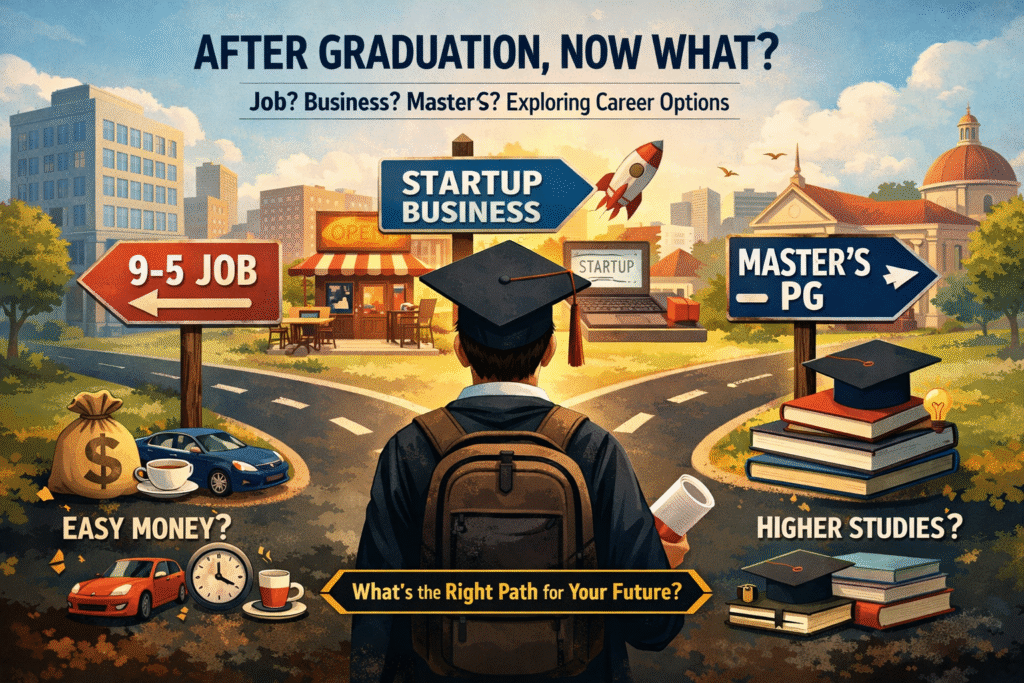
After Graduation Now What?
Convocation photos are uploaded. Caps are thrown. Relatives have congratulated you. LinkedIn is updated.
And then comes the silent question no degree prepares you for:
“What should I do after graduation?”
This is one of the most searched questions in India:
- What to do after graduation?
- Job or business after college?
- Is MBA worth it?
- Should I start a startup after engineering?
- Best career options after degree?
The modern graduate does not just face options — they face noise.
Instagram says:
“Start a business. Be your own boss.”
LinkedIn says:
“Thrilled to join a global MNC.”
YouTube says:
“Earn ₹1 lakh per month from a small café.”
Parents say:
“Get a stable job.”
And inside the mind?
Confusion, ambition, fear, excitement — all together.
This is the real challenge after graduation.
Understanding the Gen Z Career Mindset
Today’s youth wants:
- Financial independence
- Early success
- Flexible career paths
- Control over life decisions
- Meaningful work
In India especially, parents invest heavily in education. They expect stability. Sometimes they want their children to achieve what they couldn’t. Sometimes they genuinely want them to succeed in life.
This creates pressure.
Young graduates often think:
- “9–5 job is boring.”
- “Business gives freedom.”
- “MBA is outdated.”
- “Money should come fast.”
- “If I am not successful by 25, I am behind.”
This is where ambition meets unrealistic expectations.
Job vs Business After Graduation: The Reality Check
The Illusion of Easy Business Success
Social media glorifies entrepreneurship.
You see:
- Young founders opening cafés
- Startup owners earning lakhs
- Influencers talking about financial freedom
It looks simple.
But real business requires:
- Capital investment
- Cash flow planning
- Market research
- Customer retention
- Risk management
- Long-term consistency
Business is not about opening a shop.
Business is about sustaining operations for years.
There is no easy money in business.
Every rupee earned carries:
- Risk
- Responsibility
- Emotional stress
- Financial pressure
Before starting a business after graduation, ask:
- Can I survive 12–36 months without stable income?
- Do I understand my target market?
- Have I calculated expenses and break-even point?
If the answer is unclear, preparation is incomplete.
Why Taking a Job After Graduation Is Not a Bad Option
Many students search:
- Is job better than business?
- Should I work first before starting a startup?
Here is the practical truth.
A job offers:
- Industry exposure
- Professional discipline
- Real-world experience
- Networking opportunities
- Financial stability
- Understanding of how businesses operate
A job is not just income.
It is a paid learning platform.
Many successful entrepreneurs worked in companies before starting their own venture. They learned operations, finance, customer psychology, and leadership.
Working first does not mean giving up on dreams.
It means building foundation.
Is Master’s or MBA Worth It After Graduation?
Another common question:
- Should I do MBA after graduation?
- Is postgraduate degree necessary?
- Is Master’s better than job?
The answer depends on clarity.
A postgraduate degree is not an escape from confusion.
It is a specialization strategy.
Benefits of PG or MBA:
- Deeper domain knowledge
- Higher salary potential
- Leadership opportunities
- Strong professional network
- Career switch option
But if done without clear purpose, it becomes expensive delay.
PG should be pursued when:
- You want expertise in a specific field
- Your industry demands specialization
- You want structured career growth
Post-graduation is meant to groom you into an expert — not to postpone decisions.
The Biggest Career Mistake After Graduation
The biggest mistake is not choosing wrong.
The biggest mistake is staying in confusion for years.
Many graduates:
- Keep researching but never start
- Compare themselves constantly
- Wait for perfect opportunity
- Delay skill development
Clarity comes from action, not overthinking.
Time lost in indecision is difficult to recover.
Best Career Options After Graduation in India (Practical Approach)
In today’s competitive job market:
Degrees alone are not enough.
Motivation alone is not enough.
Passion alone is not enough.
What works?
Skills + Experience + Timing
For most graduates, the smart strategy is:
- Start working (job or internship).
- Build in-demand skills.
- Understand market realities.
- Save money.
- Plan long-term direction.
This approach reduces financial pressure and increases confidence.
3-Year Career Planning Strategy for Fresh Graduates
Instead of planning 20 years, plan 36 months.
Step 1: Financial Planning
- Do you need immediate income?
- Can you survive without salary for 3 years?
- Have you mapped your monthly expenses and savings?
If you cannot calculate money flow, business is risky.
Step 2: Skill Assessment
Identify your strengths:
- Technical skills
- Communication skills
- Sales ability
- Analytical thinking
- Leadership potential
Skill-based careers grow faster than degree-based careers.
Step 3: Choose a Structured Path
Examples:
- Job + Skill certification
- Work + Prepare for competitive exams
- Job + Low-risk side business
- Internship + Master’s preparation
Short-term structure reduces long-term anxiety.
Step 4: Avoid Emotional Career Decisions
Do not start business because:
- You dislike your boss
- Your friend started one
- Social media makes it look easy
- You want to escape family pressure
Start because you understand risk and responsibility.
Career Advice for Engineering and Non-Engineering Students
Whether you are:
- Engineering graduate
- Commerce graduate
- Arts student
- Science student
The fundamentals remain same:
- Build skills
- Gain exposure
- Improve communication
- Learn financial literacy
- Seek mentorship
Success is not branch-specific.
It is capability-specific.
Hard Truths About Career Growth
- There is no easy money.
- There is no overnight success.
- There are no shortcuts in career building.
- There is no guaranteed path.
Every option demands sacrifice:
- Job demands discipline.
- Business demands risk tolerance.
- Master’s demands investment.
- Government exam demands patience.
Choose your sacrifice wisely.
Final Advice: Focus on Capability, Not Image
The goal after graduation is not to look successful.
The goal is to become capable.
When you build capability:
- Money follows.
- Opportunities follow.
- Confidence follows.
Do not chase hype.
Chase mastery.
Do not rush success.
Respect timing.
Because in the end:
There is no easy money.
There are no shortcuts.
There is only consistent effort, smart planning, and disciplined execution.
And those who understand timing rarely remain confused for long.